| ID | 64031 |
| JaLCDOI | |
| FullText URL | |
| Author |
Tomita, Hayato
Department of Radiology, St. Marianna University School of Medicine
Kuramochi, Kenji
Department of Radiology, St. Marianna University School of Medicine
Fujikawa, Atsuko
Department of Radiology, St. Marianna University School of Medicine
Ikeda, Hirotaka
Department of Radiology, Fujita Health University School of Medicine
Komita, Midori
Department of Radiology, St. Marianna University School of Medicine
Kurihara, Yoshiko
Department of Radiology, Machida Municipal Hospital
Kobayashi, Yasuyuki
Department of Advanced Biomedical Imaging Informatics, St. Marianna University School of Medicine
Mimura, Hidefumi
Department of Radiology, St. Marianna University School of Medicine
|
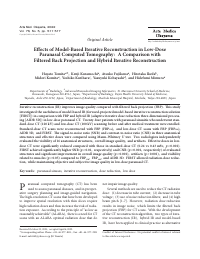
| Abstract | Iterative reconstruction (IR) improves image quality compared with filtered back projection (FBP). This study investigated the usefulness of model-based IR (forward-projected model-based iterative reconstruction solution [FIRST]) in comparison with FBP and hybrid IR (adaptive iterative dose reduction three-dimensional processing [AIDR 3D]) in low-dose paranasal CT. Twenty-four patients with paranasal sinusitis who underwent standard-dose CT (120 kV) and low-dose CT (100 kV) scanning before and after medical treatment were enrolled. Standard-dose CT scans were reconstructed with FBP (FBP120), and low-dose CT scans with FBP (FBP100), AIDR 3D, and FIRST. The signal-to-noise ratio (SNR) and contrast-to-noise ratio (CNR) in three anatomical
structures and effective doses were compared using Mann–Whitney U test. Two radiologists independently evaluated the visibility of 16 anatomical structures, overall image quality, and artifacts. Effective doses in lowdose CT were significantly reduced compared with those in standard-dose CT (0.24 vs 0.43 mSv, p<0.001). FIRST achieved significantly higher SNR (p<0.01, respectively) and CNR (p<0.001, respectively) of evaluated structures and significant improvement in overall image quality (p<0.001), artifacts (p<0.001), and visibility related to muscles (p<0.05) compared to FBP120, FBP100, and AIDR 3D. FIRST allowed radiation-dose reduction, while maintaining objective and subjective image quality in low-dose paranasal CT.
|
| Keywords | paranasal sinuses
iterative reconstruction
dose reduction
low dose
|
| Amo Type | Original Article
|
| Publication Title |
Acta Medica Okayama
|
| Published Date | 2022-10
|
| Volume | volume76
|
| Issue | issue5
|
| Publisher | Okayama University Medical School
|
| Start Page | 511
|
| End Page | 517
|
| ISSN | 0386-300X
|
| NCID | AA00508441
|
| Content Type |
Journal Article
|
| language |
English
|
| Copyright Holders | Copyright Ⓒ 2022 by Okayama University Medical School
|
| File Version | publisher
|
| Refereed |
True
|
| PubMed ID | |
| Web of Science KeyUT |