| ID | 55569 |
| FullText URL | |
| Author |
Thar Htet San
Department of Pathology and Experimental Medicine, Graduate School of Medicine, Dentistry and Pharmaceutical Sciences, Okayama University
Fujisawa, Masayoshi
Department of Pathology and Experimental Medicine, Graduate School of Medicine, Dentistry and Pharmaceutical Sciences, Okayama University
Fushimi, Soichiro
Department of Pathology and Experimental Medicine, Graduate School of Medicine, Dentistry and Pharmaceutical Sciences, Okayama University
Soe, Lamin
Department of Pathology, Myeik General Hospital
Ngu Wah Min
Department of Pathology, Sakura Specialist Hospital
Yoshimura, Teizo
Department of Pathology and Experimental Medicine, Graduate School of Medicine, Dentistry and Pharmaceutical Sciences, Okayama University
Ohara, Toshiaki
Department of Pathology and Experimental Medicine, Graduate School of Medicine, Dentistry and Pharmaceutical Sciences, Okayama University
Myint Myint Yee
Department of Pathology, Central Women Hospital
Oda, Shinsuke
Department of Pathology and Experimental Medicine, Graduate School of Medicine, Dentistry and Pharmaceutical Sciences, Okayama University
Matsukawa , Akihiro
Department of Pathology and Experimental Medicine, Graduate School of Medicine, Dentistry and Pharmaceutical Sciences, Okayama University
|
| Abstract | BACKGROUND:
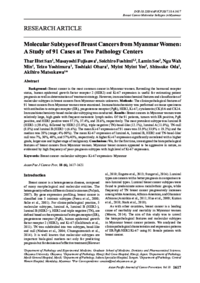
Breast cancer is the most common cancer in Myanmar women. Revealing the hormonal receptor status, human epidermal growth factor receptor 2 (HER2) and Ki-67 expression is useful for estimating patient prognosis as well as determination of treatment strategy. However, immunohistochemical features and classification of molecular subtypes in breast cancers from Myanmar remain unknown.
METHODS:
The clinicopathological features of 91 breast cancers from Myanmar women were examined. Immunohistochemistry was performed on tissue specimens with antibodies to estrogen receptor (ER), progesterone receptor (PgR), HER2, Ki-67, cytokeratin (CK)5/6 and CK14. Immunohistochemistry-based molecular subtyping was conducted.
RESULTS:
Breast cancers in Myanmar women were relatively large, high grade with frequent metastatic lymph nodes. Of the 91 patients, tumors with ER positive, PgR positive, and HER2 positive were 57.1%, 37.4%, and 28.6%, respectively. The most prevalent subtype was luminal B (HER2-) (39.6%), followed by HER2 (22.0%), triple negative (TN)-basal-like (12.1%), luminal A (11.0%), TN-null (8.8%) and luminal B (HER2+) (6.6%). The mean Ki-67 expression of 91 cases was 33.9% (33.9% ± 19.2%) and the median was 28% (range; 4%-90%). The mean Ki-67 expression of luminal A, luminal B, HER2 and TN-basal-like/ null was 7%, 30%, 40%, and 57%/43%, respectively. A higher Ki-67 expression significantly correlated with a higher grade, larger size and higher stage of malignancy.
CONCLUSIONS:
We, for the first time, investigated the histopathological features of breast cancers from Myanmar women. Myanmar breast cancers appeared to be aggressive in nature, as evidenced by high frequency of poor-prognosis subtypes with high level of Ki-67 expression.
|
| Keywords | Breast cancer
molecular subtypes
Ki-67 expression
Myanmar
|
| Note | 学位審査副論文
|
| Published Date | 2017-06-25
|
| Publication Title |
Asian Pacific journal of cancer prevention
|
| Volume | volume18
|
| Issue | issue6
|
| Publisher | Asian Pacific Organization for Cancer Prevention
|
| Start Page | 1617
|
| End Page | 1621
|
| ISSN | 1513-7368
|
| Content Type |
Journal Article
|
| language |
English
|
| OAI-PMH Set |
岡山大学
|
| Copyright Holders | https://creativecommons.org/licenses/by-nc-nd/4.0/deed.ja
|
| File Version | publisher
|
| PubMed ID | |
| DOI | |
| Related Url | isVersionOf https://doi.org/10.22034/APJCP.2017.18.6.1617
isPartOf http://ousar.lib.okayama-u.ac.jp/55521
|