| ID | 68260 |
| FullText URL | |
| Author |
Oshimi, Keisuke
Department of Chemistry, Graduate School of Life, Environmental, Natural Science and Technology, Okayama University
Ishiwata, Hitoshi
The National Institutes for Quantum Science and Technology (QST), Institute for Quantum Life Science (iQLS)
Nakashima, Hiromu
Department of Chemistry, Graduate School of Life, Environmental, Natural Science and Technology, Okayama University
Mandić, Sara
Department of Chemistry, Graduate School of Life, Environmental, Natural Science and Technology, Okayama University
Kobayashi, Hina
Department of Chemistry, Graduate School of Life, Environmental, Natural Science and Technology, Okayama University
Teramoto, Minori
Advanced Materials Laboratory, Sumitomo Electric Industries, Ltd.
Tsuji, Hirokazu
Advanced Materials Laboratory, Sumitomo Electric Industries, Ltd.
Nishibayashi, Yoshiki
Advanced Materials Laboratory, Sumitomo Electric Industries, Ltd.
Shikano, Yutaka
Institute of Systems and Information Engineering, University of Tsukuba
An, Toshu
School of Materials Science, Japan Advanced Institute of Science and Technology
Fujiwara, Masazumi
Department of Chemistry, Graduate School of Life, Environmental, Natural Science and Technology, Okayama University
ORCID
Kaken ID
publons
researchmap
|
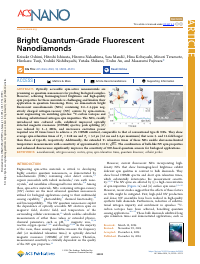
| Abstract | Optically accessible spin-active nanomaterials are promising as quantum nanosensors for probing biological samples. However, achieving bioimaging-level brightness and high-quality spin properties for these materials is challenging and hinders their application in quantum biosensing. Here, we demonstrate bright fluorescent nanodiamonds (NDs) containing 0.6–1.3-ppm negatively charged nitrogen-vacancy (NV) centers by spin-environment engineering via enriching spin-less 12C-carbon isotopes and reducing substitutional nitrogen spin impurities. The NDs, readily introduced into cultured cells, exhibited improved optically detected magnetic resonance (ODMR) spectra; peak splitting (E) was reduced by 2–3 MHz, and microwave excitation power required was 20 times lower to achieve a 3% ODMR contrast, comparable to that of conventional type-Ib NDs. They show average spin-relaxation times of T1 = 0.68 ms and T2 = 3.2 μs (1.6 ms and 5.4 μs maximum) that were 5- and 11-fold longer than those of type-Ib, respectively. Additionally, the extended T2 relaxation times of these NDs enable shot-noise-limited temperature measurements with a sensitivity of approximately 0.28K/√Hz. The combination of bulk-like NV spin properties and enhanced fluorescence significantly improves the sensitivity of ND-based quantum sensors for biological applications.
|
| Keywords | nanodiamonds
nitrogen-vacancy centers
spins
spin-relaxation times
quantum biosensor
cellular probes
|
| Published Date | 2024-12-16
|
| Publication Title |
ACS Nano
|
| Volume | volume18
|
| Issue | issue52
|
| Publisher | American Chemical Society (ACS)
|
| Start Page | 35202
|
| End Page | 35213
|
| ISSN | 1936-0851
|
| Content Type |
Journal Article
|
| language |
English
|
| OAI-PMH Set |
岡山大学
|
| Copyright Holders | © 2024 The Authors.
|
| File Version | publisher
|
| PubMed ID | |
| DOI | |
| Web of Science KeyUT | |
| Related Url | isVersionOf https://doi.org/10.1021/acsnano.4c03424
|
| License | https://creativecommons.org/licenses/by/4.0/
|
| Funder Name |
Ministry of Education, Culture, Sports, Science and Technology
Okayama University
Japan Society for the Promotion of Science
Japan Science and Technology Agency
Murata Science and Education Foundation
QST
NEDO
Japan Agency for Medical Research and Development
RSK Sanyo Foundation
Asahi Glass Foundation
|
| 助成番号 | JPMXP1223OS1022
20H00335
20KK0317
21H05599
JPMJAP2339
JPMJFS2128
23KJ1607
JPMJSP2126
JPMJFR224K
JPNP20004
JP23zf0127004
JPMJMI21G1
JPMJPR20M4
|