| ID | 64230 |
| FullText URL | |
| Author |
Takata, Jun
Faculty of Medicine, Dentistry and Pharmaceutical Sciences, Okayama University
Miyake, Naoko
Faculty of Pharmaceutical Sciences, Okayama University
Saiki, Yusuke
Faculty of Medicine, Dentistry and Pharmaceutical Sciences, Okayama University
Tada, Misako
Faculty of Pharmaceutical Sciences, Okayama University
Sasaki, Kensuke
Faculty of Medicine, Dentistry and Pharmaceutical Sciences, Okayama University
Kubo, Toshio
Department of Allergy and Respiratory Medicine, Okayama University Hospital
Kaken ID
researchmap
Kiura, Katsuyuki
Department of Allergy and Respiratory Medicine, Okayama University Hospital
ORCID
Kaken ID
publons
researchmap
Arimoto-Kobayashi, Sakae
Faculty of Medicine, Dentistry and Pharmaceutical Sciences, Okayama University
|
| Abstract | Background
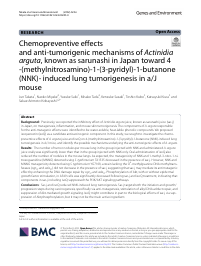
Previously, we reported the inhibitory effect of Actinidia arguta juice, known as sarunashi juice (sar-j) in Japan, on mutagenesis, inflammation, and mouse skin tumorigenesis. The components of A. arguta responsible for the anti-mutagenic effects were identified to be water-soluble, heat-labile phenolic compounds. We proposed isoquercetin (isoQ) as a candidate anticarcinogenic component. In this study, we sought to investigate the chemopreventive effects of A. arguta juice and isoQ on 4-(methylnitrosamino)-1-(3-pyridyl)-1-butanone (NNK)-induced lung tumorigenesis in A/J mice, and identify the possible mechanisms underlying the anti-tumorigenic effects of A. arguta. Results The number of tumor nodules per mouse lung in the group injected with NNK and administered A. arguta juice orally was significantly lower than that in the group injected with NNK only. Oral administration of isoQ also reduced the number of nodules in the mouse lungs. As expected, the mutagenicity of NNK and 1-methyl-3-nitro-1-nitrosoguanidine (MNNG) detected using S. typhimurium TA1535 decreased in the presence of sar-j. However, NNK and MNNG mutagenicity detected using S. typhimurium YG7108, a strain lacking the O6-methylguanine DNA methyltransferases (ogtST and adaST) did not decrease in the presence of sar-j suggesting that sar-j may mediate its antimutagenic effect by enhancing the DNA damage repair by ogtST and adaST. Phosphorylation of Akt, with or without epidermal growth factor stimulation, in A549 cells was significantly decreased following sar-j and isoQ treatment, indicating that components in sar-j including isoQ suppressed the PI3K/AKT signaling pathways. Conclusions Sar-j and isoQ reduced NNK-induced lung tumorigenesis. Sar-j targets both the initiation and growth/progression steps during carcinogenesis, specifically via anti-mutagenesis, stimulation of alkyl DNA adduct repair, and suppression of Akt-mediated growth signaling. IsoQ might contribute in part to the biological effects of sar-j via suppression of Akt phosphorylation, but it may not be the main active ingredient. |
| Keywords | Akt signal transduction
Lung tumorigenesis
Anti-mutagenesis
DNA methylation
Tobacco-specific nitrosamine
Isoquercetin
|
| Published Date | 2022-12-09
|
| Publication Title |
Genes and Environment
|
| Volume | volume44
|
| Issue | issue1
|
| Publisher | Springer Science and Business Media LLC
|
| Start Page | 26
|
| ISSN | 1880-7062
|
| Content Type |
Journal Article
|
| language |
English
|
| OAI-PMH Set |
岡山大学
|
| Copyright Holders | © The Author(s) 2022.
|
| File Version | publisher
|
| PubMed ID | |
| DOI | |
| Web of Science KeyUT | |
| Related Url | isVersionOf https://doi.org/10.1186/s41021-022-00255-0
|
| License | https://creativecommons.org/licenses/by/4.0
|