| ID | 69191 |
| フルテキストURL | |
| 著者 |
Okawa, Yukari
Department of Public Health and Welfare, Zentsuji City Hall
Mitsuhashi, Toshiharu
Center for Innovative Clinical Medicine, Okayama University Hospital
Kaken ID
researchmap
Tsuda, Toshihide
Graduate School of Medicine, Dentistry and Pharmaceutical Sciences, Okayama University
ORCID
Kaken ID
researchmap
|
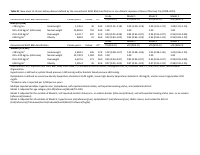
| 抄録 | Background/Objectives: Obesity is a risk factor for chronic kidney disease (CKD) in Asians. The Asia-Pacific body mass index (BMI) classification sets lower obesity cutoffs than the conventional BMI classification for all races, generally reflecting the lower BMIs in Asians. This longitudinal study evaluated the association between BMI, as classified by the Asia-Pacific BMI system, and CKD development in non-diabetic Asian adults. Methods: A population-based longitudinal study (1998–2023) was conducted in non-diabetic Japanese adults (hemoglobin A1c < 6.5%) in Zentsuji City (Kagawa Prefecture, Japan). The generalized gamma model was used to assess the relationship between time-varying BMI categories and CKD development, stratified by sex. CKD was defined as an estimated glomerular filtration rate of <60 mL/min/1.73 m2. BMI was calculated as weight (kg) divided by the square of height (m2) and categorized per the Asia-Pacific classification as overweight (23.0–24.9 kg/m2), obesity class I (25.0–29.9 kg/m2), and obesity class II (≥30.0 kg/m2). Results: CKD developed in 34.2% of 3098 men and 34.8% of 4391 women. The mean follow-up times were 7.41 years for men and 8.25 years for women. During follow-up, the BMI distributions for men were 5.0% underweight, 43.3% normal weight, 25.6% overweight, 24.1% obesity class I, and 2.0% obesity class II; those for women were 7.7%, 50.5%, 20.5%, 18.3%, and 2.9%, respectively. Compared with normal weight, obesity class I was associated with a 6% (95% confidence interval [CI]: 2–10%) shorter time to CKD onset in men and 5% (95% CI: 2–7%) in women. In both sexes, obesity class II showed shorter survival times than normal weight by point estimates, although all 95% CIs crossed the null value. Conclusions: Obesity, as classified by the Asia-Pacific BMI system, shortened the time to CKD onset in non-diabetic Asians. The conventional BMI cutoff for obesity (≥30.0 kg/m2) may be too high to identify CKD risk in this population. The findings of this study may be useful for public health professionals in designing interventions to prevent CKD.
|
| キーワード | body mass index
chronic kidney disease
East Asian
longitudinal studies
risk factors
|
| 発行日 | 2025-02-05
|
| 出版物タイトル |
Biomedicines
|
| 巻 | 13巻
|
| 号 | 2号
|
| 出版者 | MDPI AG
|
| 開始ページ | 373
|
| ISSN | 2227-9059
|
| 資料タイプ |
学術雑誌論文
|
| 言語 |
英語
|
| OAI-PMH Set |
岡山大学
|
| 著作権者 | © 2025 by the authors.
|
| 論文のバージョン | publisher
|
| PubMed ID | |
| DOI | |
| Web of Science KeyUT | |
| 関連URL | isVersionOf https://doi.org/10.3390/biomedicines13020373
|
| ライセンス | https://creativecommons.org/licenses/by/4.0/
|
| Citation | Okawa, Y.; Mitsuhashi, T.; Tsuda, T. The Asia-Pacific Body Mass Index Classification and New-Onset Chronic Kidney Disease in Non-Diabetic Japanese Adults: A Community-Based Longitudinal Study from 1998 to 2023. Biomedicines 2025, 13, 373. https://doi.org/10.3390/biomedicines13020373
|