| ID | 69863 |
| フルテキストURL | |
| 著者 |
Yang, Xiangfu
Graduate School of Interdisciplinary Science and Engineering in Health Systems, Okayama University
Yang, Weiping
Department of Psychology, Faculty of Education, Hubei University
Yu, Yinghua
Graduate School of Interdisciplinary Science and Engineering in Health Systems, Okayama University
ORCID
Ejima, Yoshimichi
Graduate School of Interdisciplinary Science and Engineering in Health Systems, Okayama University
Kaken ID
Yang, Jiajia
Graduate School of Interdisciplinary Science and Engineering in Health Systems, Okayama University
ORCID
Kaken ID
publons
researchmap
|
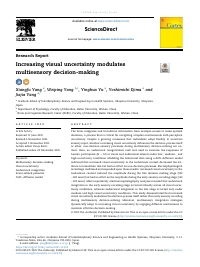
| 抄録 | The brain integrates and transforms information from multiple senses to make optimal decisions, a process that is critical for navigating complex environments with perceptual uncertainty. Despite a growing consensus that individuals adapt flexibly to uncertain sensory input, whether increasing visual uncertainty influences the decision process itself or other, non-decision sensory processes during multisensory decision-making are unclear. Here, an audiovisual categorization task was used to examine the responses of human participants (N = 30) to visual and audiovisual stimuli under low-, medium-, and high-uncertainty conditions. Modeling the behavioral data using a drift‒diffusion model indicated that increased visual uncertainty in the audiovisual context decreased the evidence accumulation rate but had no effect on non-decision processes. Electrophysiological recordings confirmed and expanded upon these results: increased visual uncertainty in the audiovisual context reduced the amplitude during the late decision-making stage (300–380 msec) but had no effect on the amplitude during the early sensory encoding stage (140–220 msec). More importantly, electroencephalography analyses revealed that audiovisual integration in the early sensory encoding stage occurred robustly across all visual uncertainty conditions, whereas audiovisual integration in the late stage occurred only under medium and high visual uncertainty conditions. This study demonstrated that increased visual uncertainty modulates the decision process itself rather than early sensory encoding during multisensory decision-making. Moreover, multisensory integration strategies dynamically adapt to increasing visual uncertainty by engaging different mechanisms to maintain effective decision-making.
|
| キーワード | Multisensory decision-making
Visual uncertainty
Audiovisual integration
Event-related potential
Drift‒diffusion model
|
| 発行日 | 2026-01
|
| 出版物タイトル |
Cortex
|
| 巻 | 194巻
|
| 出版者 | Elsevier BV
|
| 開始ページ | 50
|
| 終了ページ | 62
|
| ISSN | 0010-9452
|
| NCID | AA00619737
|
| 資料タイプ |
学術雑誌論文
|
| 言語 |
英語
|
| OAI-PMH Set |
岡山大学
|
| 著作権者 | © 2025 The Author(s).
|
| 論文のバージョン | publisher
|
| PubMed ID | |
| DOI | |
| Web of Science KeyUT | |
| 関連URL | isVersionOf https://doi.org/10.1016/j.cortex.2025.11.005
|
| ライセンス | http://creativecommons.org/licenses/by%2Dnc%2Dnd/4.0/
|
| 助成情報 |
JPMJFR2041:
柔軟な視覚・運動連関を生む脳領野間ダイナミクス
( 国立研究開発法人科学技術振興機構 / Japan Science and Technology Agency )
25K02549:
ヒト大脳皮質の層別機能から探る多感覚統合の脳内情報処理機構
( 独立行政法人日本学術振興会 / Japan Society for the Promotion of Science )
|